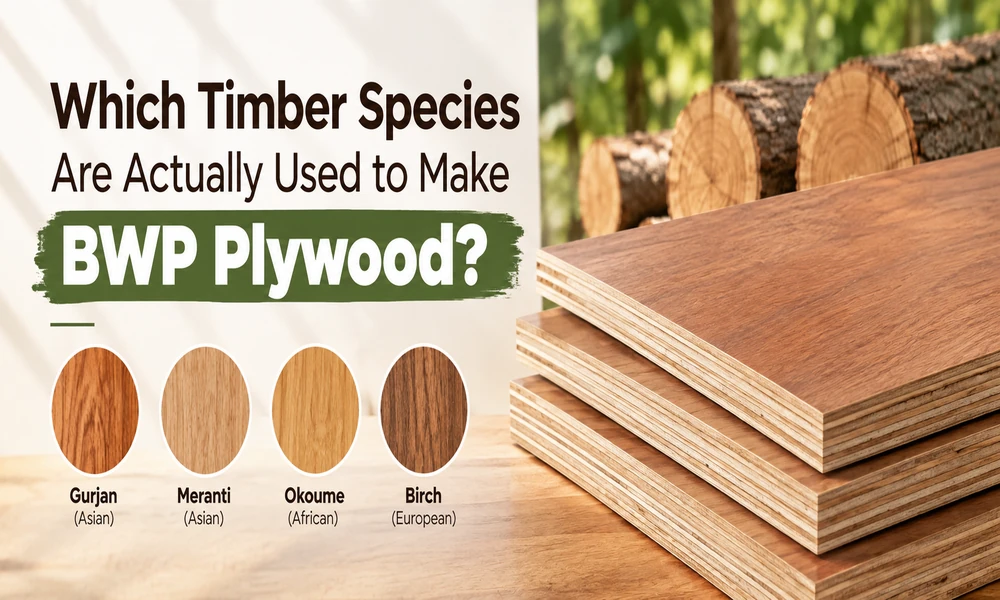
When talking about Boiling Waterproof plywood, customers typically concentrate on two things: the type of resin used to manufacture the plywood and the product’s associated waterproofing claim or IS 710 certification. However, another element included in the term “Boiling Waterproof” describes the type of timber used to manufacture the ply. Different manufacturers can use a variety of timber combinations while still complying with the required grade and specifications for manufacturing.
At Royale Touche, the documented timber species used to manufacture Royale Touche’s BWP and Marine Grade Plywood include Diptocarpus spp, commonly known as Gurjan, and selected hardwoods like Eucalyptus spp., where Gurjan is specified for both face veneers. Gurjan is a dense species of hardwood and is botanically identified as Diptocarpus spp. Gurjan possesses many characteristics of hardness, durability, dimensional stability and screw-holding ability, making it a good timber for use in plywood construction, as the finished panel will hold the weight of a piece of furniture, hardware, and be used regularly.
Gurjan Face Veneers and Core Construction
In Royale Touche’s documented “Boiling Waterproof” specifications, Gurjan is specified as the species used to manufacture the face veneers. Thus, the finished face of a sheet of plywood is made of Gurjan, with the ability to use either selected hardwoods specified for the product in the internal construction. In essence, the core species of plywood can differ from the face veneer species.
Royale Touche uses specific hardwoods in its BWP and Marine Grade plywood, which are Gurjan and Eucalyptus spp. In general, the layered construction of plywood is what makes it unique. Veneer sheets are arranged in layers where the grain of the wood is oriented crosswise to one another before they are glued together. When laminates are glued together, the resulting plywood combines the characteristics of the timber with the structural benefits of the cross-laminated veneer design.
How Timber and Manufacturing Affect Waterproofing
However, how the timber performs in terms of waterproofing is not just based on the type of timber used; rather, it is a combination of how the timber is manufactured and then treated to create a waterproof product. The BWP specification indicates that a high-solid BWP-grade phenolic polymer was used as the adhesive. To ensure that the plywood can maintain the waterproof designation, the manufacturer applied a four-step chemical treatment process that included a protective covering of the veneers, the resin, the adhesive and the surface.
In addition, the specification also references an entire plywood sheet made from fully composed veneer laminations so that there are no voids or “lap” joints within the veneer sheets, and both sides of the sheet will be calibrated. This means that the way the wood has been manufactured and treated, combined with the choice of wooden material and bonding material (the phenolic polymer), are what ultimately contribute to producing the final BWP sheet.
Understanding the Separation of Face Veneer and Core Timber
Just because the term “Gurjan” appears in a product specification does not mean that all of the veneers in that plywood sheet will be Gurjan; it only indicates that the face veneers are likely using Gurjan for construction. Therefore, when comparing BWP sheets from multiple manufacturers or suppliers, it is important to review the entire construction specification to avoid assuming all sheets are the same due to their appearance or because the marketing material describes the sheet by the type of timber used.
Buyers should use the same process of determining the timber species of the face and core veneers before making a purchase. For example, a BWP sheet may contain Gurjan on the face but may contain a different species or combinations of species within the core. This method will provide more consistent and accurate comparisons between competing suppliers and also allow for critical insight into how the veneers have been manufactured before actual purchase.
What to Look for in BWP Plywood
Start by understanding the grade and certification that all of the BWP sheets meet, then look at how those BWP sheets are constructed according to the IS 710 specifications provided by the manufacturer. That specification will identify the timber species used to make the face and core veneers, the tufted design and the application of the edge for any gaps or laps, as well as confirm that the thickness of the BWP sheet matches the IS 710 specifications.
The documented BWP/Marine-grade product of Royale Touche is manufactured using Diptocarpus spp. (Gurjan) on both faces, Eucalyptus spp. as an additional selected hardwood, with both the Gurjan and Eucalyptus spp. used to manufacture the full-composed core. By providing this information in conjunction with the BWP specification, buyers have more information than simply reading the term “waterproof plywood.”
Conclusion
BWP plywood is not dependent on one particular timber species. The manufacturing process used to make BWP plywood determines the ability of timber utilised in the construction of BWP plywood and the resulting BWP product to be waterproof. BWP sheets from the document(Royale Touche) indicate a species combination of Diptocarpus spp. (Gurjan) and also a selected hardwood species, which is Eucalyptus spp. Additionally, both Gurjan and Eucalyptus spp. were used to produce the full-composed core; thus, for buyers to accurately understand the quality of a BWP sheet they are purchasing, checking the timber utilised in producing it is very important.